
Start with the vial
The compound amount in mg, as printed on the vial.
Three steps between a prescription in milligrams and a mark on the syringe.
The compound amount in mg, as printed on the vial.

The bacteriostatic water you reconstituted it with. This sets the concentration.

Your prescribed weekly dose in mcg, mg or IU.
A GLP-1 dosing calculator turns a prescribed dose into the numbers you use at the syringe. It matters for compounded and reconstituted vials, where you decide the concentration, and barely at all for fixed-dose branded pens, where somebody else already did.
Prescriptions are written in milligrams. Injections are drawn in millilitres, read off in syringe units. Between those three sit a vial strength and a volume of water, and getting one of them wrong changes the dose without changing anything you can see.
The MAX Peptide AI GLP-1 dosing calculator handles that conversion and only that conversion. It has no opinion on what you should be taking. What it works out is the relationship between:
This tool checks math. It does not replace anything your prescriber told you.
The core job is dose in, volume out.
Take a 5 mg vial with 2 ml of water added. That is 2.5 mg/ml. Ask it for a 0.5 mg dose and the draw is 0.2 ml.
On a U-100 insulin syringe, 0.2 ml is 20 units.
That last number is what anyone reaching for a semaglutide calculator or a tirzepatide dosage calculator actually came for.
| Input | What it Means | Example |
|---|---|---|
| Vial strength | Total medication in the vial | 5 mg |
| Diluent added | Total liquid added to the vial | 2 ml |
| Concentration | Medication per ml after mixing | 2.5 mg / ml |
| Desired dose | Dose prescribed or selected | 0.5 mg |
| Draw volume | How much liquid to inject | 0.2 ml |
| U-100 syringe units | Syringe marking equivalent | 20 units |
Enter the vial correctly and the same tool serves tirzepatide and semaglutide dosing equally well, along with the rest of the class.
Semaglutide is what is inside Ozempic and Wegovy. Tirzepatide is what is inside Mounjaro and Zepbound. Branded pens arrive at fixed strengths; compounded and reconstituted vials leave the math to you.
Hence the steady search traffic for a semaglutide reconstitution calculator or a tirzepatide reconstitution calculator. The brand on the vial changes nothing: total milligrams divided by total millilitres gives concentration, every time.
Some context helps before the numbers. Both compounds are started low and titrated upward over weeks, because escalating slowly is what makes them tolerable. Going up fast is how people end up unable to continue at all.
The charts below are reference material, not instructions. They reflect typical branded schedules. Your own plan depends on the product, the indication, how you are tolerating it, your history, and what your prescriber decided.
Semaglutide schedules differ by product and purpose. Ozempic is indicated for type-2 diabetes, Wegovy for weight management, and the escalation reflects that.
| Schedule | Common Weekly Dose | Typical Timing | Notes |
|---|---|---|---|
| Starting dose | 0.25 mg once weekly | Weeks 1-4 | Usually used for initiation, not as the main maintenance dose. |
| Early maintenance / escalation | 0.5 mg once weekly | Weeks 5 and onward | Common next step after 4 weeks. |
| Higher dose option | 1 mg once weekly | After at least 4 weeks at 0.5 mg | Often used when more effect is needed. |
| Highest dose option | 2 mg once weekly | After at least 4 weeks at 1 mg | Common maximum Ozempic injection dose. |
Read that as background, then use the calculator for the part it covers: how many ml, and how many units, correspond to whichever step you are on.
Tirzepatide escalates the same way, in steps. Mounjaro and Zepbound share strengths but are approved and marketed for different indications.
| Schedule | Common Weekly Dose | Typical Timing | Notes |
|---|---|---|---|
| Starting dose | 2.5 mg once weekly | Weeks 1-4 | Initial dose. |
| First maintenance step | 5 mg once weekly | Weeks 5 and onward | Common first ongoing dose. |
| Escalation option | 7.5 mg once weekly | After at least 4 weeks at 5 mg | Intermediate step. |
| Maintenance option | 10 mg once weekly | After at least 4 weeks at 7.5 mg | Common higher maintenance dose. |
| Escalation option | 12.5 mg once weekly | After at least 4 weeks at 10 mg | Intermediate step. |
| Maximum adult dose | 15 mg once weekly | After at least 4 weeks at 12.5 mg | Common maximum adult dose. |
A tirzepatide dosage calculator earns its place here: it converts the weekly dose into a draw volume for whatever concentration your vial ended up at.
A calculator has nothing to say about whether it is time to move up a step. It works out the volume once the dose and the vial are already decided.
Branded pens are built at fixed strengths and often deliver one set dose per click. There is no concentration to work out and nothing to convert.
Vials are the opposite. The same milligrams can end up at any concentration, decided entirely by how much water went in.
That is why a GLP-1 reconstitution calculator is a vial tool. Change the water, change the concentration, change the units, all without changing the dose on the prescription.
Two divisions, and almost every mistake comes from confusing milligrams, millilitres and syringe units rather than from the math itself.
Milligrams are the drug. Millilitres are the liquid. Syringe units are marks on a barrel and have nothing to do with dose.
Concentration is the bridge: how much drug sits in each ml.
First division:
Concentration = total medication in vial / total liquid volume
Worked across common vials:
| Vial Amount | Diluent Added | Final Concentration |
|---|---|---|
| 5 mg | 1 ml | 5 mg / ml |
| 5 mg | 2 ml | 2.5 mg / ml |
| 10 mg | 2 ml | 5 mg / ml |
| 10 mg | 4 ml | 2.5 mg / ml |
| 15 mg | 3 ml | 5 mg / ml |
Everything downstream depends on this figure. Get the concentration wrong and every number after it is wrong by the same factor, silently.
Second division:
Draw volume = dose / concentration
Again, worked through:
| Desired Dose | Concentration | Draw Volume |
|---|---|---|
| 0.25 mg | 2.5 mg / ml | 0.1 ml |
| 0.5 mg | 2.5 mg / ml | 0.2 ml |
| 1 mg | 2.5 mg / ml | 0.4 ml |
| 2.5 mg | 5 mg / ml | 0.5 ml |
| 5 mg | 10 mg / ml | 0.5 ml |
Which is the point of the tool. Almost nobody wants the formula; they want to know where to stop pulling the plunger.
Small subcutaneous doses are drawn on U-100 insulin syringes, where 1 ml is 100 units:
Dose, concentration, draw volume and units all on one screen is the whole advantage over doing it by hand. Not because the math is hard, but because four numbers held in your head while handling a vial is where errors live.
GLP-1 compounds are not equivalent milligram for milligram. Never use a calculator to convert yourself from one drug to another.
Titration means the dose moves every few weeks. Vials get reordered along the way, and they do not always arrive at the strength the last one was. This is where a stable protocol quietly stops being stable.
Say you have been drawing 20 units of a 5 mg vial reconstituted with 2 ml, which is 2.5 mg/ml, for a 0.5 mg dose. The next vial is 10 mg, reconstituted with the same 2 ml:
Muscle memory is the problem. After a month of drawing to the same line, the line becomes the dose, and a new vial silently redefines it.
Two habits that prevent it:
Write the strength, the water and the date on the vial when you mix it. The next person confused by that vial is usually you, three weeks later.
The result is only as good as what went in. Before acting on any figure, confirm the vial strength, the liquid added, the dose, and the syringe.
The full list:
This matters most with a semaglutide or tirzepatide reconstitution calculator, where the final concentration comes entirely from the mixing instructions you followed.
A calculator is not a prescriber. It knows nothing about your diagnosis, your current step, your side effects, your labs, your other medications or your history.
Changed dose, changed pharmacy, moved from a pen to a vial, moved between compounds, or received a vial at a different strength than last time? Ask your healthcare provider before you draw.
 MAX Peptide AI
 Semaglutide, tirzepatide and retatrutide, with your vial and concentration saved. Every shot is one tap away.
A weekly reminder when the dose is due, a log of every injection and side effect, and vial dates so nothing expires unnoticed.
Watch the weight trend across each step up, see whether nausea settles, and follow your levels between weekly shots.
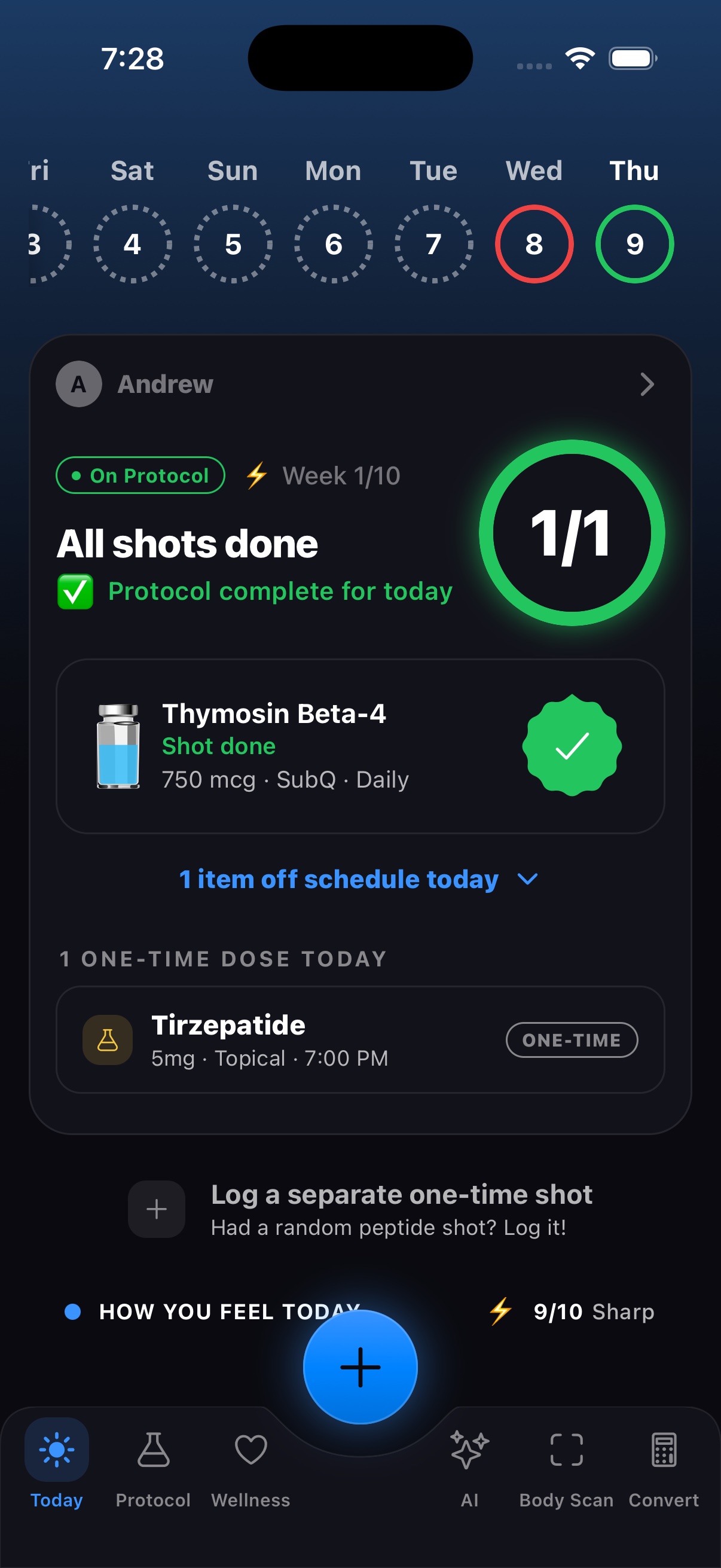
Enter your prescribed GLP-1 dose and the vial you are drawing from, and the calculator returns the units to draw. No login, no math.
Prescribed dose in, units on a U-100 syringe out. Two divisions you no longer have to run while holding a vial.
The whole class, at any vial strength and any amount of water. The compound changes the schedule, not the math.
Enter a dose to get the units, or enter the units you drew to get the dose. The second one is how you check a shot after the fact.
Results appear as you type. Nothing to install, no account, and none of it leaves the page.
It converts a dose in milligrams into an injection volume and syringe units. That matters for compounded or reconstituted vials, where you set the concentration yourself and nothing on the label tells you what to draw. Paired with a tracker like MAX Peptide AI, the vial and the mix stay saved between doses.
Yes, provided the vial strength, the diluent volume and the prescribed dose are the ones actually in front of you. It works as a semaglutide reconstitution calculator too, since the concentration step is the same regardless of which compound is in the vial.
Because units are what you can actually see on the barrel. Small subcutaneous doses are drawn on U-100 syringes, where 100 units is 1 ml. Converting a volume into units turns a decimal into a mark, and a mark is far easier to draw to accurately.
They are two halves of one job, and most tools do both. Reconstitution is the first division: what concentration you ended up with after adding water. Dosing is the second: what volume and how many units carry the prescribed dose at that concentration.
No. The calculator turns one prescribed dose into the units to draw for that compound; it does not compare compounds to each other. Semaglutide and tirzepatide are not equivalent milligram for milligram, and each carries its own titration schedule, so a switch in either direction is a prescribing decision rather than a math problem. Run the numbers on the compound and the dose you were actually prescribed.
Usually there is no need. Pens are built at fixed strengths and deliver a set dose, so there is nothing to reconstitute and nothing to convert. The calculator is for compounded, multi-dose and reconstituted vials, where concentration and draw volume are yours to work out.
