
Vial IU and water
The IU printed on the vial, and the BAC water you added.
Three steps between a vial of powder and the mark to draw to.
The IU printed on the vial, and the BAC water you added.

Your prescribed dose per injection, or one of the presets.

The units to draw on a U-100 syringe, with concentration and doses per vial.
An HCG calculator turns the amount of human chorionic gonadotropin in a vial into a volume you can actually draw. Give it the vial strength, the diluent you added and the prescribed dose, and it returns the concentration and the volume that carries that dose.
HCG ships as a freeze-dried powder and is measured in International Units, or IU. Nothing can be drawn until the powder is reconstituted with the diluent supplied with it (or one your clinician or pharmacist has approved).
The concentration is decided entirely by how much liquid you add. Less liquid gives a stronger solution, more gives a weaker one. The total IU in the vial does not change either way, only how much volume carries a given dose.
All of them printed on something in front of you:
Out comes the concentration in IU/mL and the volume for that dose, mapped onto the markings of a U-100 insulin syringe so you can see where to stop pulling.
Check every figure against the vial and the prescription before you draw. The calculator repeats your math, it does not read your label.
Concentration first:
Total HCG in vial / diluent volume = concentration in IU per ml
A 5,000 IU vial mixed with 5 mL:
5,000 IU / 5 mL = 1,000 IU/mL
Then the volume:
Prescribed dose / concentration = injection volume
At a 250 IU dose:
250 IU / 1,000 IU/mL = 0.25 mL
The MAX Peptide AI HCG reconstitution calculator runs both steps together and shows the result on a syringe, so there is no intermediate figure to carry in your head or write on the box.
Three different things, and two of them are called units in casual conversation. IU measures biological activity. Millilitres measure volume. Syringe units measure volume too, on a particular barrel, and are not IU of HCG.
On a U-100 insulin syringe:
| Syringe Marking | Liquid Volume |
|---|---|
| 10 units | 0.10 ml |
| 20 units | 0.20 ml |
| 25 units | 0.25 ml |
| 50 units | 0.50 ml |
| 100 units | 1.00 ml |
25 units is 0.25 mL on every U-100 syringe ever made. How much HCG sits in that 0.25 mL depends entirely on how you mixed the vial, which is why two people can draw the same units and take different doses.
Not every syringe uses this scale. Confirm yours is U-100 before applying any of these conversions.
Anyone running HCG next to testosterone or a peptide hits this immediately: every other vial in the drawer is labelled in milligrams, and this one is not.
The reason is that HCG is a large glycoprotein rather than a small molecule. Its effect depends on how the molecule is built, not just on how much of it there is by weight. Two preparations of identical mass can differ in activity, so the dose is defined by a biological assay and expressed in International Units.
What follows from that, practically:
This is the single most common source of HCG dosing errors, and none of the math involved is difficult. It is a labelling difference, not a math problem.
HCG is a prescription medicine with defined requirements for mixing, storage and administration. The vial label and the paperwork that came with it outrank any general calculator, this one included.
Use the diluent supplied with the product, or one a licensed healthcare professional named specifically. Sterile and bacteriostatic water are not interchangeable.
Some multidose presentations come with a preserved diluent containing benzyl alcohol, which carries its own cautions, particularly in infants.
Never pick a diluent off an online mixing guide.
Check both labels, both strengths and both expiry dates before anything is opened. Run the diluent slowly down the inside wall of the vial. Swirl gently if the product information permits it. Do not shake, and do not freeze.
Look at the solution every time. Discoloured, unusually cloudy or carrying particles means do not use it, unless the product information describes exactly that appearance as normal.
There is no single shelf life for reconstituted HCG.
Some brands direct that multidose vials be refrigerated at 2°C to 8°C (36°F to 46°F) and discarded after 60 days. Others give the same temperature range and 30 days. Some formulations are meant to be used immediately.
The window that applies is the one printed for your brand, your diluent and your formulation. Write the mixing date on the vial, store it as directed, and discard it when that period is up.
Take the number to a pharmacist or the prescribing clinician if:
Seek medical attention immediately for trouble breathing, swelling of the face or throat, severe pelvic or abdominal pain, or any other severe symptom after taking HCG.
 MAX Peptide AI
 HCG, peptides and GLP-1s, with your vial and mix already saved. Every dose is one tap from the home screen.
Schedule HCG and TRT, get a reminder when a dose is due, and log the shot and the site as you go.
Upload your bloodwork and get AI-powered insights. Watch testosterone, estradiol and the rest move across the protocol.
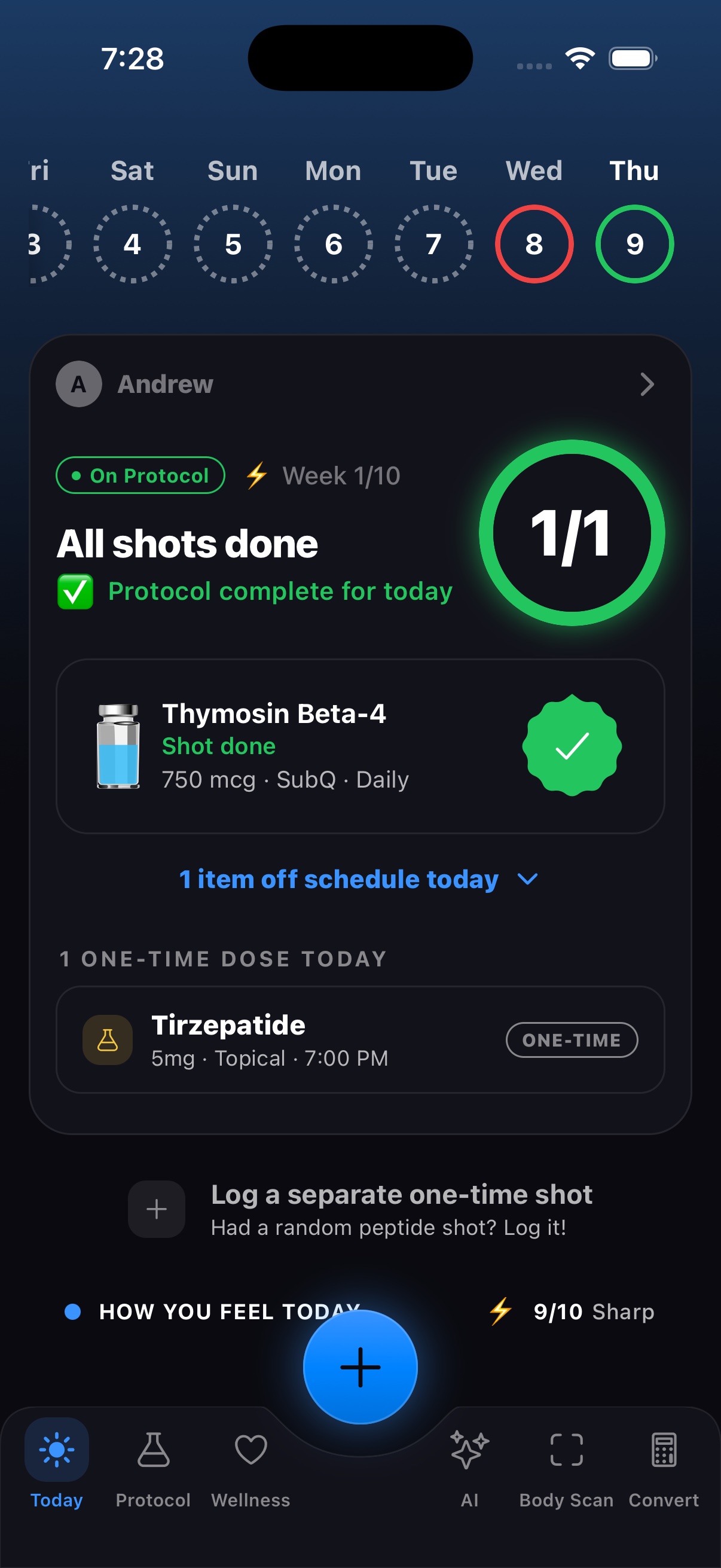
The MAX Peptide AI HCG calculator takes any HCG vial and any amount of bacteriostatic water and returns the concentration, the volume, and the units to draw.
Any vial strength, any diluent volume, any dose in IU, converted to U-100 units. No intermediate figure to write down.
2,000, 5,000 and 10,000 IU vials at whatever volume you reconstituted them with. Change the water and the units follow.
The dose is drawn on a syringe, not just printed as a number. Checking a mark against a picture beats re-reading a decimal.
Results move as you type, presets included. Nothing to install, nothing to sign up for, nothing leaves the page.
It converts a prescribed dose in IU into a liquid volume, using your vial strength and the diluent you added, then shows where that volume sits on a U-100 syringe. Two steps that are easy to get right separately and easy to muddle together.
There is no fixed answer, and assuming one is where people go wrong. A unit is 0.01 mL on a U-100 syringe. The IU in that 0.01 mL depends on how you mixed the vial: at 1,000 IU/mL it is 10 IU, at 2,000 IU/mL it is 20. Working that out is exactly what this calculator is for.
It depends on the formulation. Pregnyl labelling allows up to 60 days refrigerated after reconstitution; Novarel states 30. Some products are meant to be used straight away. The only period that applies is the one printed for the product you are holding.
No. Calculators and trackers convert a dose you already have; none of them can decide what that dose should be. The dose, the schedule and the route are for a licensed healthcare professional to set.
No. The right diluent varies by product. Some multidose presentations come with a bacteriostatic diluent, others use sterile water, others something else again. Follow the prescription label and what your pharmacist told you, not a general guide.
Do not inject until you know why. Re-check the vial strength, the diluent volume, the prescribed IU and the syringe type, since one of those four is almost always the answer. If they all look right and the numbers still disagree, ask the pharmacist or prescriber to confirm the volume.
