
Start with the vial
The strength printed on the vial, in milligrams.
Three steps stand between a vial of powder and the number of units to draw.
The strength printed on the vial, in milligrams.

How much bacteriostatic water went into the vial, in mL.

Your dose per injection in micrograms. The units appear as you type.
A peptide calculator (also called a reconstitution calculator or a peptide dosage calculator) takes the two numbers you already have, the peptide in your vial and the water you added to it, and turns them into the one number you need: how far to pull the plunger.
It answers two questions that are easy to get wrong on paper:
Doing both by hand means two conversions and a division, usually while holding a vial. Peptides are active in micrograms, so a decimal in the wrong place is not a rounding error, it is a different dose entirely. The MAX Peptide AI peptide calculator does both steps at once and shows the result on a syringe.
Pick your peptide, enter what is in the vial, enter the diluent you added, enter the dose you want, and choose your syringe. Every conversion between mg, mcg, mL and units happens as you type.
What comes back:
If the dose does not fit the syringe you picked, the calculator says so instead of quietly returning a number you cannot draw. If the dose lands somewhere hard to read on the barrel, it suggests a water volume that puts it on a clean mark.
You have a 10mg vial. You add 2mL of bacteriostatic water. You want 500mcg per injection. Here is the math the peptide dosage calculator runs:
500mcg is 10 units, and the vial holds 20 doses.
More water means a weaker solution and a bigger draw for the same dose; less water means the opposite. Neither is wrong, but a dose under 5 units is hard to measure accurately. Check the number against the syringe drawing before you inject.
The charts below cover the mixes people reach for most often. All of them assume a U-100 insulin syringe, where 100 units is 1mL.
Dose-to-Units Reference
| Peptide in Vial (mg) | Diluent Added (mL) | Concentration (mcg/mL) | 250 mcg Dose Volume | Syringe Units (U-100) |
|---|---|---|---|---|
| 2 mg | 1 ml | 2000 | 0.125 mL | 13 |
| 5 mg | 2 ml | 2500 | 0.10 mL | 10 |
| 10 mg | 2 ml | 5000 | 0.05 mL | 5 |
| 10 mg | 3 ml | 3333 | 0.075 mL | 7.5 |
| 15 mg | 3 ml | 5000 | 0.05 mL | 5 |
| 15 mg | 5 ml | 3000 | 0.083 mL | 8.3 |
Example: 5mg vial + 2mL = 2500mcg/mL, so 250mcg = 0.10mL (10 units). Adjust values to your dose, as needed.
Types of Syringes
| Syringe | Notes |
|---|---|
| Insulin Syringe (U-100) 0.3 mL (30U) | Fine gradations (0.5–1U) for small doses; 1U = 0.01 mL. Great for <50 mcL draws. |
| Insulin Syringe (U-100) 0.5 mL (50U) | Mid-range syringe; still 100U/mL. Use when doses are moderate. |
| Insulin Syringe (U-100) 1.0 mL (100U) | Most common. 1U = 0.01 mL; best for larger volumes. |
| Tuberculin Syringe 1 mL (100U) | Same graduations as U-100 (1U = 0.01 mL). Can be used equivalently. |
| Other Syringes (U-40) | Do not use U-40 syringes for peptide dosing. U-40 has 40 units/mL, and applying U-100 math would cause a x2.5 error. |
Types of Diluents
| Diluent | Notes |
|---|---|
| Bacteriostatic Water | Preservative allows multi-dose vials (stable ~28 days refrigerated). Standard choice for most peptide protocols. |
| Sterile Water | No preservative - use only once. Use within 24 hours and discard unused solution. |
| Normal Saline | Usually not recommended for peptides (pH can differ). If used, note that it does not contain a preservative. |
Lyophilised peptide arrives as a powder. Keep the vial at 2-8 °C if you will use it soon, or at -20 °C if it is going to sit. Once it is in solution:
Let both the powder and the diluent come to room temperature before you mix them. Cold glass and cold liquid make the powder dissolve slowly, which tempts people into shaking the vial.
Nothing that is not a sterile pharmaceutical diluent belongs in a peptide vial. Tap water, flavoured saline and additive-carrying solutions all degrade the peptide and introduce contaminants.
Every one of these produces a number that looks reasonable and is not. They come up far more often than math errors do.
Everything above is for research and educational purposes and is not a substitute for professional medical advice.
 MAX Peptide AI
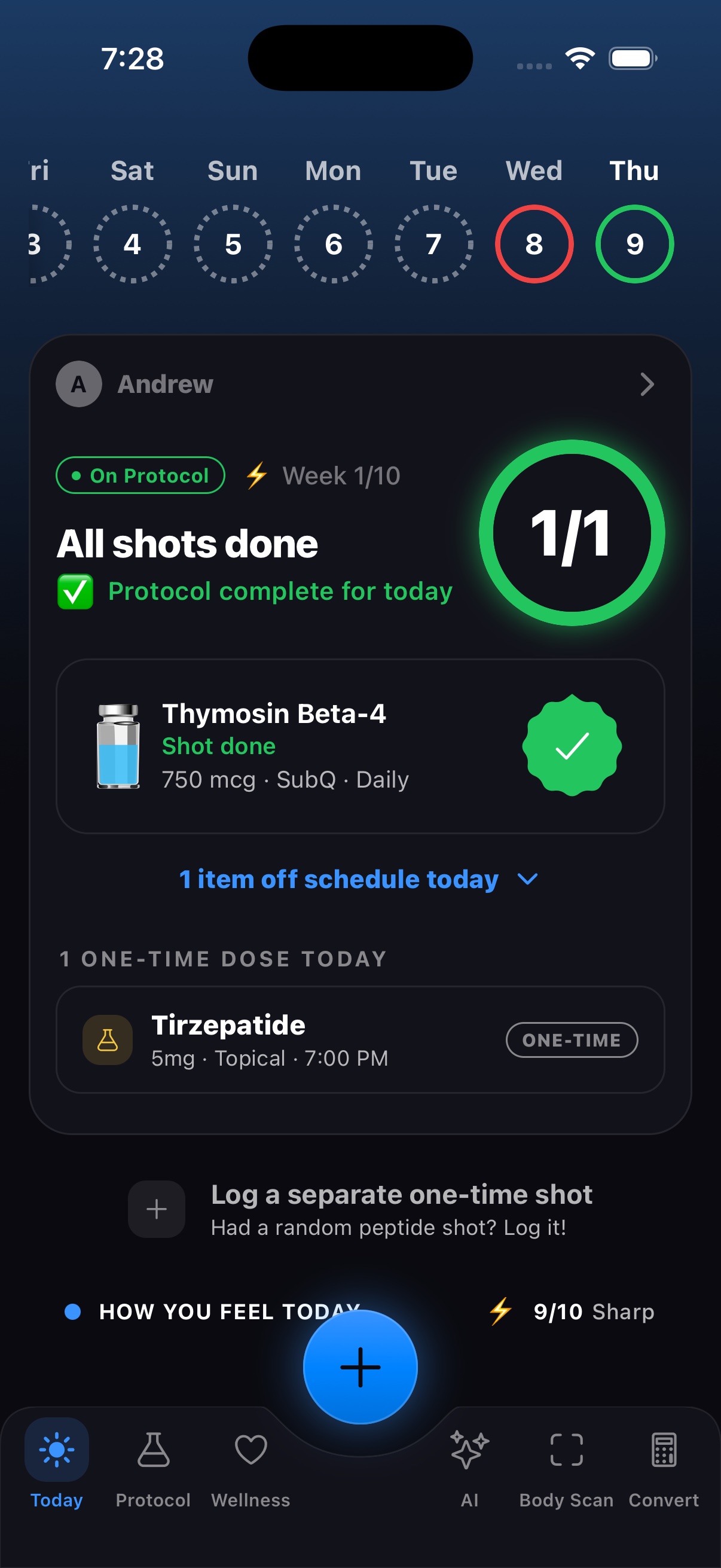
 The same reconstitution math, with your vials already saved. Open a compound and the dose is one tap away.
Schedule each compound, get a reminder when a dose is due, and log the shot and the site as you go.
Upload your bloodwork and get AI-powered insights. Watch your markers move against the protocol that produced them.
The MAX Peptide AI peptide calculator does the reconstitution and the dosage in one place, so nothing has to move between two tools.
Pick from 30+ peptides instead of typing their details in. Each one arrives with the vial sizes and dose ranges it is normally run at.
Mixing and dosing happen on one screen. Change the water and the units update, so you can find the dilution that suits your dose.
One compound, a stack, or a multi-peptide vial. Blends break down per component, which is where the math usually goes wrong.
Work in mcg, mg or IU and switch at any point. The dose is rescaled rather than reinterpreted, so the number stays the dose you meant.
It works out how concentrated your vial is once you have mixed the powder with water, and how much of that solution one dose is. Enter the vial amount, the water you added and the dose you want, and it returns the volume in mL and the units to draw on the syringe.
1mg is 1,000mcg. On a U-100 insulin syringe 100 units is 1mL, so 1 unit is 0.01mL: 0.1mL reads as 10 units, 0.05mL as 5. The MAX Peptide AI peptide reconstitution calculator prints both the mL and the unit count, so you never have to run the conversion yourself.
No. The unit figures assume a U-100 insulin syringe, where 100 units is 1mL. Veterinary U-40 syringes hold 40 units per mL, so reading U-100 numbers on one is a 2.5x overdose. For anything under 10 units, a 0.3mL (30U) barrel has finer gradations and is easier to read accurately.
MAX Peptide AI covers reconstitution and dosing in the same place, then keeps the protocol afterwards. The calculator on this page is the same engine the app runs. The difference is that in the app your vials, doses and injection history stay saved, so you are not re-entering the same mix every week.
That depends on how concentrated you want the result. Most 5-10mg vials are mixed with 1-3mL. More water means a weaker solution and a larger draw for the same dose. Rather than guessing, enter a volume in the MAX Peptide AI peptide calculator and look at where the dose lands on the syringe. If it is under 5 units, use less water.
Yes, with no account and no limit on how often you use it. It is an informational and research tool, not medical advice, so follow your supplier's handling instructions and the rules that apply where you are. If you want the same calculations alongside your protocol, doses and progress, the MAX Peptide AI app carries all of it.
