
Enter your details
Age, sex, height, weight and activity level, in metric or imperial.
Three steps between your measurements and a calorie target.
Age, sex, height, weight and activity level, in metric or imperial.

Know your body-fat percentage? It switches the calculation to a formula based on lean mass.

Your calorie targets, plus the protein range that protects lean mass.
A TDEE calculator estimates the total energy your body spends in a day. TDEE stands for Total Daily Energy Expenditure: everything you burn over 24 hours, not just what you burn in the gym.
The figure moves with age, sex, weight, height, body composition and how active you are. Most of it is spent while you are doing nothing in particular, keeping a heart beating, blood moving, food digesting and a body at temperature.
Knowing the number is what turns weight management from guesswork into math. Whether the goal is losing fat, holding a weight or adding muscle, every one of those is defined relative to what you burn.
Looking for a free TDEE calculator? Fill in the fields above and the estimate appears immediately, with no account and no email.
Your Basal Metabolic Rate (BMR) is what you would burn lying still all day. For most people it is the largest single slice of the total, which surprises anyone who assumes exercise dominates.
Movement is the slice that varies most between two otherwise identical people. Someone on their feet all day with a training habit can sit far above someone the same size who sits at a desk.
Digestion takes its own cut. Breaking food down and absorbing it costs energy, known as the Thermic Effect of Food, and it is the smallest of the three.
The MAX Peptide AI TDEE calculator runs on published, validated equations rather than a rule of thumb.
It calculates your BMR from your measurements first, then applies the multiplier that matches the activity level you selected. The product of those two is your estimated Total Daily Energy Expenditure.
No TDEE calculator measures what you burn. It estimates it from population averages, and for most healthy adults that estimate is a good place to start and a poor place to stop.
The activity multipliers this calculator applies:
| Activity Level | Description |
|---|---|
| Sedentary | Little or no exercise. |
| Lightly Active | Light exercise 1-3 days per week. |
| Moderately Active | Moderate exercise 3-5 days per week. |
| Very Active | Hard exercise 6-7 days per week. |
| Extremely Active | Physical job or intense daily training. |
Where you land against the average depends on muscle mass, genetics, how hard you actually train, and everything you do outside of training. Treat the output as a starting point, then let a few weeks of real weight data correct it.
The point of the number is deciding what to eat against it.
Your TDEE is maintenance. Eat around it and your weight holds over time. Moving weight in either direction means deliberately sitting above or below it.
| Goal | Recommended Approach |
|---|---|
| Weight Loss | Consume fewer calories than your TDEE. |
| Weight Maintenance | Consume approximately your TDEE. |
| Muscle Gain | Consume slightly more calories than your TDEE. |
An honest maintenance figure is what makes a deficit a decision rather than an accident.
A moderate deficit survives contact with real life; a severe one usually does not. Around 300-500 calories per day below maintenance is where most people can hold a rate of loss they will still be following in two months.
The thing that separates people who lose weight from people who keep restarting is not the size of the deficit. It is how many weeks in a row it actually happened.
To hold your weight, eat somewhere around your estimated TDEE and leave it alone long enough to see whether it worked.
Day-to-day weight swings are water, food volume and timing, not fat. Judge maintenance on a multi-week trend line, never on this morning's number.
Adding muscle needs three things at once: a modest surplus, resistance training that progresses, and enough protein to build with.
Start slightly above maintenance and give it a few weeks. A bigger surplus does not buy faster muscle, it buys faster fat.
The most common complaint about calorie targets is that they stop working after a couple of months. They usually do, and not because the calculator was wrong.
The fix is not a harsher deficit, it is a fresh number. Recalculate every 4-6kg of change or every couple of months, whichever comes first, and set the next target from the body you have now.
A TDEE calculator for women uses the same equations as for men. Sex is already one of the inputs, alongside height, weight and age, so nothing separate is needed.
Women do typically land on different calorie figures than men of the same height, mostly through differences in body composition. The method does not change: get your daily expenditure, then set intake above, below or at it depending on the goal.
Whether you came here for maintenance calories or for a free TDEE calculator to lose fat, the same handful of variables drive the answer.
 MAX Peptide AI
 Weight, measurements and photos in one trend line, so you can adjust calories before progress stalls.
Intake, GLP-1 or TRT protocol, timing and how you felt. The context that explains a number on the scale.
Upload your bloodwork and get AI-powered insights, read alongside data from your connected devices.
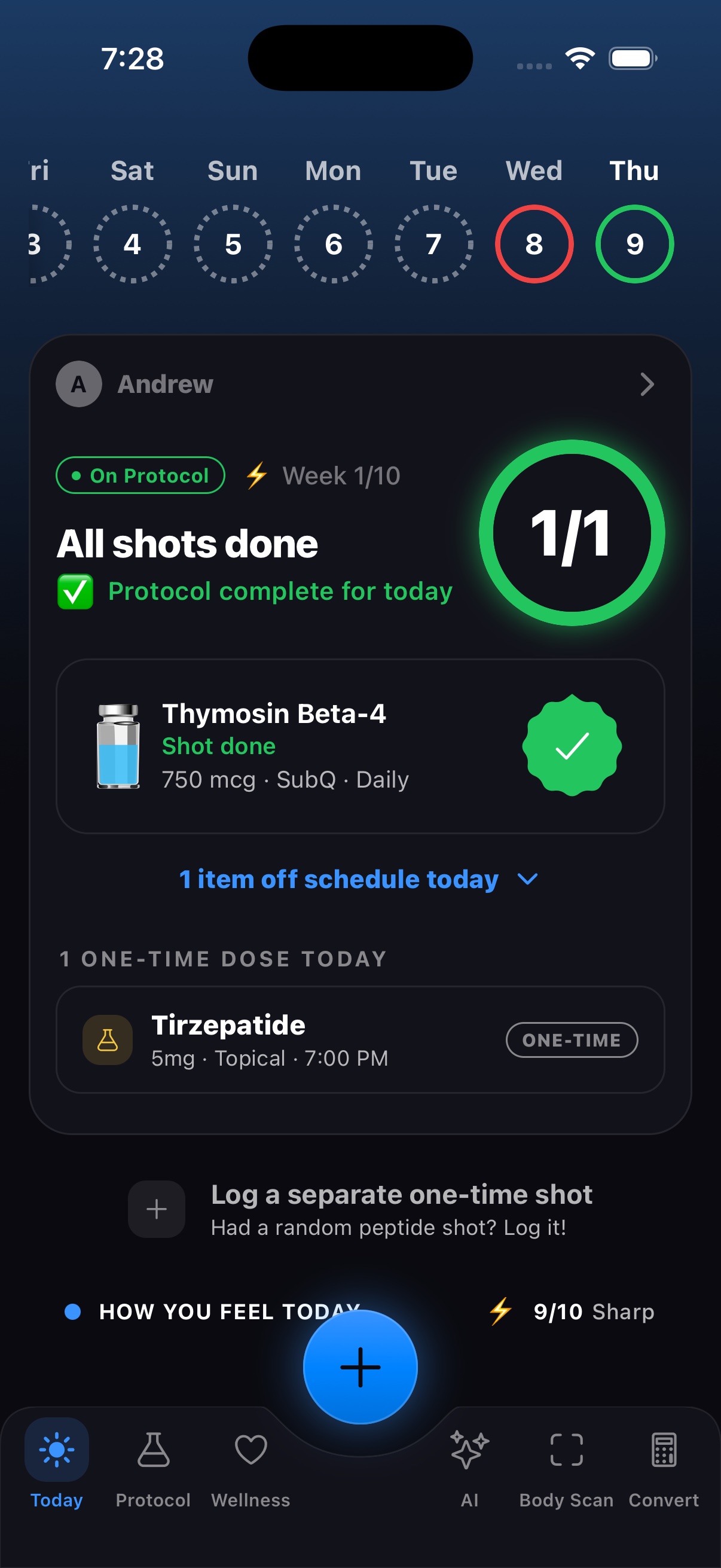
The MAX Peptide AI TDEE calculator estimates what you burn each day and turns that number into calorie and protein targets.
Maintenance plus a deficit and a surplus figure, worked out at the same time. No second calculation to decide where to set intake.
The two equations for what you burn at rest. Mifflin-St Jeor works from age, sex, height and weight; Katch-McArdle works from lean mass, so it is the sharper of the two once you know your body fat.
A protein range sized to you, not a flat number. It is what protects lean mass while the calorie figure does its work.
On a GLP-1, running TRT, or neither. The calorie and protein targets are the ones that fit the goal you are actually chasing.
BMR is what you would burn at complete rest. TDEE is BMR plus everything else: movement, training and digestion. BMR is the floor, TDEE is the actual daily total, and it is TDEE that you set calorie targets against.
Whenever your weight or your activity has moved meaningfully. A practical rule is every 4-6kg of change, or every couple of months. A smaller body burns less, so a target set 10kg ago is describing someone else.
If you are eating at maintenance, a stable weight is the calculator working correctly. If you meant to be in a deficit and nothing is moving, the usual causes are tracking drift, water retention, and less incidental movement than you think. Give it three weeks of data before changing anything, then adjust from the trend rather than from a single weigh-in.
It is an estimate built from population equations, so expect to be within a few hundred calories rather than exact. That is enough to start with. Two weeks of weight data will tell you more about your real expenditure than any formula can, so treat the output as a hypothesis to test.
Yes, and it is the usual reason people run one. It gives you the maintenance figure, and a deficit only means something once you know what you are subtracting from. Most people do best 300-500 calories below maintenance, which is a rate that survives a bad week.
It is, with no account and no limit. Enter your details, get your maintenance calories, your targets and a protein range. If you want those numbers tracked against your actual weight over time, the MAX Peptide AI app does that part.
