
Pick the vial concentration
The mg/ml printed on the vial. This is the number that decides the volume.
Three steps between a prescription in milligrams and a mark on the syringe.
The mg/ml printed on the vial. This is the number that decides the volume.

A weekly total or a per-injection dose, and how often you inject.

The ml per injection, and the same volume in units on a U-100 syringe.
The TRT dosage calculator takes four inputs and returns the only number you need at the point of drawing.
Decide whether you are working from a weekly total or a per-injection amount. Enter the milligrams. Select the concentration printed on the vial. Choose how many times a week you inject.
Back comes the volume per injection in ml, and the same volume as units on a U-100 syringe.
This is an informational tool. Dose and injection frequency are set by your healthcare professional, and the calculator assumes you already have both.
The table below runs the standard dose-to-volume conversion across the three concentrations you will actually encounter: 100 mg/ml, 200 mg/ml, and 250 mg/ml.
| Dose | 100 mg/ml | 200 mg/ml | 250 mg/ml |
|---|---|---|---|
| 50 mg | 0.5 ml | 0.25 ml | 0.20 ml |
| 75 mg | 0.75 ml | 0.375 ml | 0.30 ml |
| 100 mg | 1.0 ml | 0.50 ml | 0.40 ml |
| 125 mg | 1.25 ml | 0.625 ml | 0.50 ml |
| 150 mg | 1.50 ml | 0.75 ml | 0.60 ml |
| 175 mg | 1.75 ml | 0.875 ml | 0.70 ml |
| 200 mg | 2.0 ml | 1.0 ml | 0.80 ml |
Underneath everything, a TRT dosage calculator is a dose-to-volume converter and one division:
ml per injection = dose (mg) / concentration (mg/ml)
60 mg prescribed per injection from a 200 mg/ml vial is 0.3 ml.
On a 1 ml U-100 insulin syringe, 1 ml is 100 units, so 0.3 ml reads as 30 units, 0.50 ml as 50, and 0.75 ml as 75. Those markings measure volume, never dose. The same 30 units from a different vial strength is a different amount of testosterone, which is why the syringe type and the vial concentration both get checked before you draw.
A worked case, start to finish:
120 mg across two injections is 60 mg each. 60 mg divided by 200 mg/ml is 0.30 ml. That is 30 units on a U-100 1 mL syringe.
Esters come up constantly in TRT math, usually with more anxiety than they deserve.
Every ester delivers testosterone, and the dose-to-volume conversion does not change between them. Cypionate, enanthate or propionate, the calculator divides milligrams by mg/ml the same way.
What does change is the schedule:
| Ester | Approx. Half-Life | Common Concentrations |
|---|---|---|
| Testosterone cypionate | 7-8 days | 100 mg/ml, 200 mg/ml |
| Testosterone enanthate | 4-5 days | 200 mg/ml, 250 mg/ml |
| Testosterone propionate | 1.5-2 days | 100 mg/ml |
Shorter esters clear faster, which is why they tend to be injected more often: fewer days between shots means smaller peaks and troughs. The volume calculation is identical regardless.
One injection a week means the whole weekly amount converts at once. Simplest math, largest single volume.
Two injections means halving the weekly milligrams before converting to ml, not after. This is the step people skip, and it is the reason most users come to a testosterone dose calculator: they know the weekly figure and need the per-shot draw.
Three injections means dividing by three first. That usually produces an awkward decimal, so the tool rounds to something you can actually read on a barrel.
All of the following assume a 200 mg/ml vial:
| Weekly total | 1 injection per week | 2 injections per week | 3 injections per week |
|---|---|---|---|
| 100 mg/week | 100 mg = 0.50 ml | 50 mg = 0.25 ml | 33.3 mg = 0.17 ml |
| 150 mg/week | 150 mg = 0.70 ml | 75 mg = 0.375 ml | 50 mg = 0.25 ml |
| 200 mg/week | 200 mg = 1.0 ml | 100 mg = 0.50 ml | 66.7 mg = 0.33 ml |
Nothing in TRT dosing catches people out more reliably than a refill at a different concentration. The prescription is unchanged, the label looks familiar, and the volume you have drawn for months is now wrong.
Same 100 mg dose, three vials:
Keep drawing 50 units after moving from a 200 mg/ml vial to a 250 mg/ml vial and you are taking 125 mg instead of 100, a 25% increase that no symptom will announce and only bloodwork will find.
What makes it easy to miss:
Re-run the calculator every time a vial changes, even when the prescription has not. It takes ten seconds and it is the only step that catches this.
The output is only as good as the three numbers going in. Confirm the dose in mg, the concentration in mg/ml and the injection frequency before drawing, because correct math on a wrong input is still a wrong volume in the syringe.
This calculator supports a prescribed plan; it does not modify one. Monitoring matters once testosterone therapy has started: the Endocrine Society recommends checking hematocrit at baseline, at 3-6 months, and annually thereafter, with prostate monitoring where appropriate.
Royal Berkshire NHS guidance adds regular review of testosterone levels, full blood count, PSA, liver function, lipids, and blood pressure.
This page is not medical advice. It does not diagnose low testosterone, suggest a starting dose, or establish whether TRT is appropriate for you. Those are decisions for a qualified clinician.
 MAX Peptide AI
 Testosterone, HCG, peptides and GLP-1s in seconds, with your ester and concentration already saved.
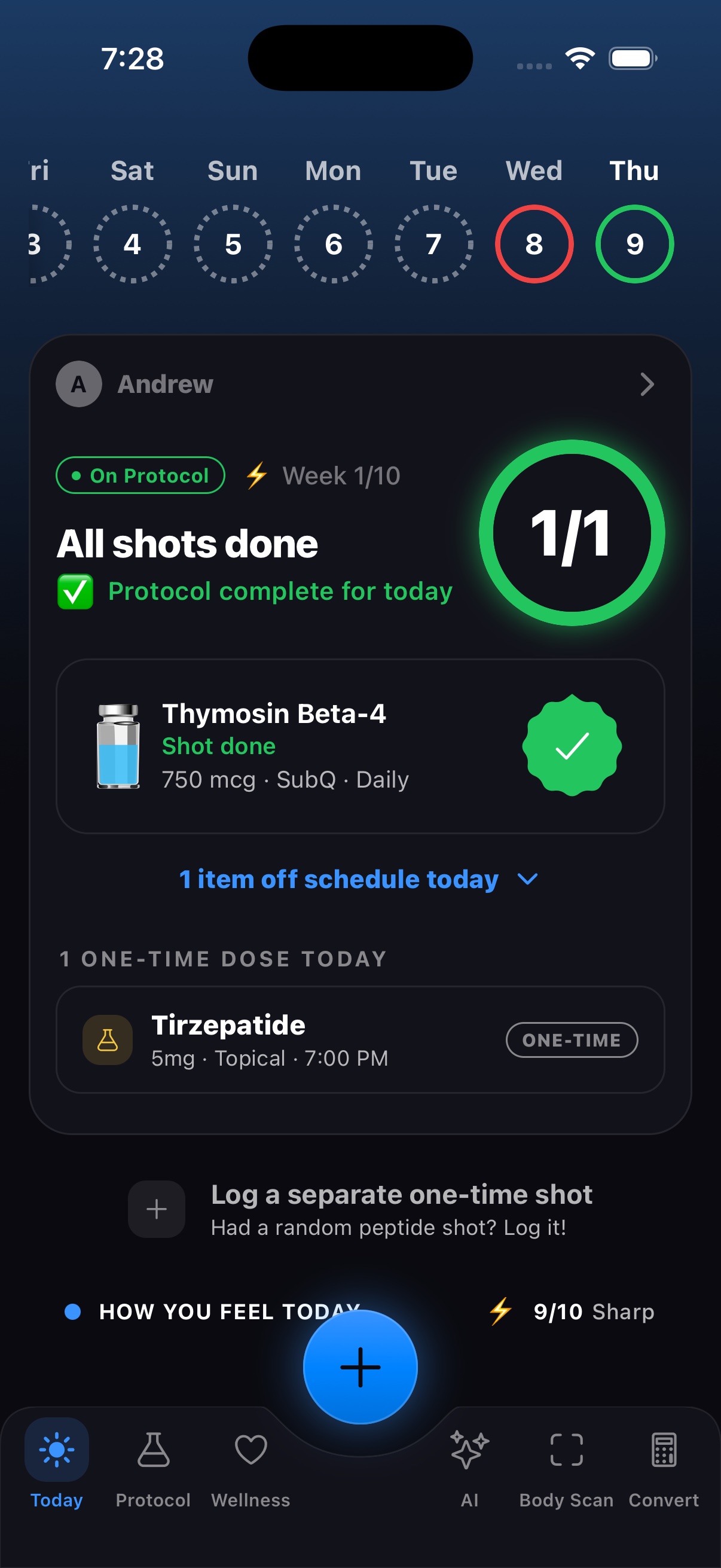
Schedule the protocol, get reminded when a dose is due, and log each injection and site to keep the rotation honest.
A half-life visualiser estimates testosterone between shots. Upload your bloodwork to follow total T, free T, estradiol and hematocrit.
Enter your weekly TRT prescription and the concentration printed on your vial, and this calculator returns the exact volume to draw for every injection. No login, no math.
Dose in, concentration in, volume and syringe units out. The conversion happens as you type rather than after a submit.
Cypionate, enanthate, propionate, Sustanon. The ester changes the schedule, not the math, and the calculator handles all of them.
No subscription, no paywall, no account. Open the page, get the number, close the page.
Start from a weekly total or from a single shot. The split is done for you, which is where the math usually slips.
Divide the dose for one injection (in mg) by the vial concentration (in mg/ml). If you are starting from a weekly total, split it by the number of injections first, then convert. Multiply the resulting ml by 100 for units on a U-100 syringe.
Most TRT starts somewhere around 75-100 mg per week. The AUA names 100 mg weekly as a preferred starting dose, and Endocrine Society guidance lists 75-100 mg weekly or 150-200 mg every two weeks for cypionate or enanthate. Where you sit within that is a clinical decision, not a calculation.
Follow whatever schedule your prescriber set. Arithmetically it is the weekly total divided by the number of injections, then converted to ml. The calculator does not propose a schedule, it works out the per-injection volume for the one you already have.
It depends entirely on the vial. At 100 mg/ml it is 1.0 ml; at 200 mg/ml, 0.5 ml; at 250 mg/ml, 0.4 ml. Same dose, three different draws, which is why the concentration matters as much as the prescription. Keeping the protocol in one place stops that number drifting between refills.
Yes, and it is the most common cause of an accidental dose change. The mg stays as prescribed while the volume moves: a stronger vial means a smaller draw for the same dose. Re-run the numbers whenever a refill arrives at a different concentration.
No. It converts a prescribed dose into an injection volume and nothing more. Guideline-based care needs symptoms, confirmed low testosterone on repeat testing, and ongoing monitoring, none of which a calculator can supply.
